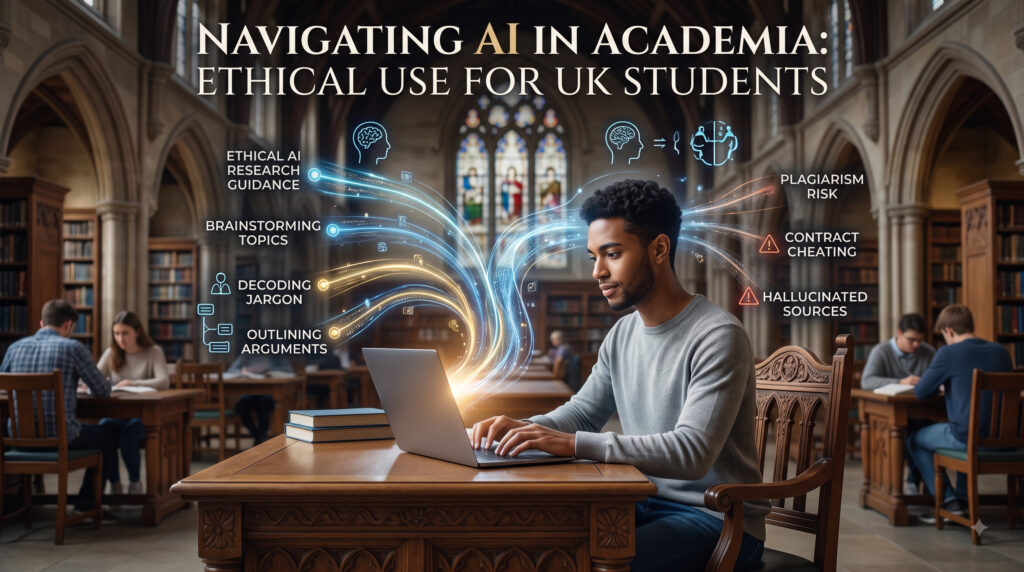
Navigating AI in Academia: How UK Students Can Ethically Use AI Tools for Research
Artificial Intelligence is fundamentally changing how students study, research, and write. Tools like ChatGPT, Claude, and Perplexity offer incredible capabilities, but for UK university students, they also bring a massive wave of anxiety.
With universities constantly updating their academic integrity policies and investing heavily in AI detection software, many students are terrified of accidentally committing academic misconduct. The fear is so prevalent that many are left wondering why Turnitin detectors are flagging original work.
The truth is, most UK universities are not asking you to ignore AI completely—they are asking you to use it ethically. In this guide, we will break down the clear boundaries between helpful AI assistance and academic misconduct, and show you how to safely leverage these tools to enhance your research.
The Current Stance of UK Universities on AI
The initial panic of 2023 is over. Today, bodies like the Russell Group have published guiding principles on AI in education. Instead of outright bans, the focus has shifted to AI literacy and transparency.
However, grading rubrics remain strict. Here is a quick breakdown of how universities view AI usage:
| AI Activity | University Stance | Consequence / Outcome |
| Generating text and submitting it as your own | Strictly Prohibited | Severe academic misconduct, potential module failure or expulsion. |
| Using AI to translate an entire essay | Prohibited | Flags as plagiarism or contract cheating; loses your original academic voice. |
| Asking AI to explain a complex theory | Encouraged | Enhances understanding, similar to a digital study buddy. |
| Using AI to brainstorm structure | Permitted (Usually) | Must be properly acknowledged in a declaration statement if required by your department. |
3 Ways to Ethically Use AI for Your Assignments
If you want to use AI to boost your productivity without crossing the line, you must treat the AI as a research assistant, not an author. Here are three safe, ethical ways to use it.
1. Brainstorming and Topic Generation
Staring at a blank page is the hardest part of any assignment. If you are struggling to choose the perfect dissertation topic, AI can act as an excellent sounding board.
The Ethical Approach: Prompt the AI with your broad interests. For example, if you are writing about the future of artificial intelligence in healthcare, you can ask: “What are 5 niche, debatable topics regarding AI data privacy in NHS hospitals?” You can then take those ideas and research them independently using Google Scholar.
2. Demystifying Complex Academic Jargon
Academic journal articles are notorious for dense, unreadable language. If you are stuck on a specific methodology or a philosophical concept, AI can help translate it into plain English.
The Ethical Approach: Copy a difficult paragraph from a journal article and ask the AI: “Explain this concept to me as if I were a first-year undergraduate.” Once you understand the core concept, close the AI tab and write your own analysis based on your new understanding.
3. Outlining and Structuring Arguments
Sometimes you have all the research, but you don’t know how to piece it together. AI can help you visualize the flow of your essay.
The Ethical Approach: Feed the AI your main points and ask: “What is a logical way to structure an essay using these arguments?” It might suggest an order that helps you develop a coherent argument, but the actual drafting, referencing, and critical analysis must be 100% your own.
The Red Lines: What Constitutes Academic Misconduct?
The line between assistance and cheating is easily crossed if you aren’t paying attention. To avoid academic disciplinary hearings, never do the following:
-
Copy-pasting generated text: Even if you change a few words, AI detectors and experienced tutors will recognize the robotic, repetitive structure of AI writing.
-
Relying on AI for citations (Hallucinations): AI models frequently invent (or “hallucinate”) fake authors, journal titles, and DOIs. Always use your university library to find real, verifiable sources.
-
Failing to declare AI use: If your module handbook requires you to submit an “AI Declaration Form,” fill it out honestly. Transparency is your best defense.
For a deeper dive into the boundaries of university rules, read our comprehensive guide on ethical academic support and misconduct in UK universities.
Human Expertise vs. Artificial Intelligence
While AI is a great tool for brainstorming, it lacks the nuanced critical thinking required to secure a First-Class degree in the UK. AI writes descriptively; university markers reward critical synthesis.
If you want to ensure your work is original, deeply analytical, and perfectly aligned with British academic standards, human expertise is irreplaceable. At SchoolUs, our academic specialists provide:
-
Bespoke Content Guidance: Ethical support to structure your arguments without relying on generative bots.
-
Proofreading & Editing: Ensuring your unique voice shines through with perfect grammar, flow, and structural integrity.
Frequently Asked Questions (FAQs)
Will Turnitin flag my essay if I use Grammarly?
Standard spelling and grammar checkers (like the basic version of Grammarly) are generally accepted by UK universities and will not trigger Turnitin’s AI flags. However, using advanced “rewrite this paragraph” or generative AI features within Grammarly can trigger detection. Always stick to basic proofreading tools.
What should I do if I am falsely accused of using AI?
If Turnitin flags your original work, do not panic. Gather your evidence. Tutors look at your version history on Microsoft Word/Google Docs, your rough notes, and your downloaded journal articles. Being able to show the progressive drafting of your essay is the best way to prove human authorship.
Can I use AI to write my literature review?
No. AI cannot critically evaluate the methodology, bias, or gaps in literature—which is the entire point of a literature review. It can help you summarize individual papers for your own notes, but the synthesis must be written by you.
Don’t risk your academic integrity. If you need help refining your essay, trust experienced UK academics over algorithms. Get matched with a professional at SchoolUs to guide your writing ethically and effectively.