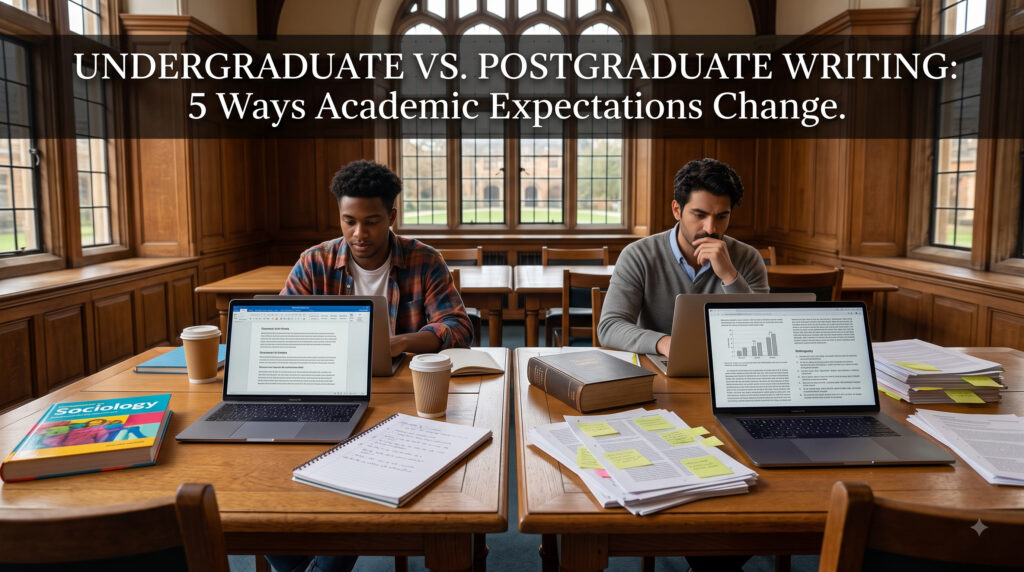
Undergraduate vs. Postgraduate Writing: 5 Ways Academic Expectations Change
Starting a Master’s degree in the UK is an exciting milestone, but it often comes with a severe dose of academic shock. Many students who consistently achieved First-Class marks during their Bachelor’s degree are devastated when their first postgraduate essay comes back with a 55% or a lower 2:2.
If this has happened to you, do not panic. The issue is rarely a lack of intelligence or effort; it is a fundamental misunderstanding of the new grading criteria.
A postgraduate degree is not simply “more of the same.” The expectations shift dramatically. To succeed at the Master’s level, you must elevate your writing from demonstrating knowledge to creating new insights. Here are the five critical ways academic writing expectations change when you transition from an undergraduate to a postgraduate programme.
1. The Shift from Descriptive to Deeply Critical
At the undergraduate level, tutors expect you to understand and explain existing theories. While critical analysis is required for top grades, a well-structured descriptive essay might still scrape a passing mark.
At the postgraduate level, pure description will result in a fail.
The Postgraduate Expectation: You are no longer just a student learning a subject; you are a junior academic participating in a debate. You must ruthlessly evaluate the literature. Instead of stating what a theorist said, you must dissect why they said it, identify the flaws in their methodology, and explain why it matters to your specific argument. If you are struggling to make this leap, revisiting the fundamentals of writing a critical analysis essay is absolutely essential.
2. Independent Research Replaces Reading Lists
During your undergraduate years, module handbooks often provided exhaustive reading lists. If you read the core textbook and three recommended journal articles, you had enough material to write a solid essay.
The Postgraduate Expectation: Your reading list is now just a starting point. Master’s tutors expect you to conduct highly independent, self-directed research. You are expected to find contemporary, niche peer-reviewed articles that were not mentioned in your lectures. When it comes time to choose the perfect dissertation topic, you must identify a genuine gap in the existing literature, rather than simply rehashing a broad, heavily researched subject.
3. Methodological Rigour Becomes Paramount
Undergraduate essays often focus entirely on the results of research. You might cite a statistic or a conclusion without questioning how that data was gathered.
The Postgraduate Expectation: Postgraduate writing places a massive emphasis on methodology. Tutors want to know that you understand how knowledge is constructed. You must question the sample sizes, biases, and analytical tools used by other researchers. If your Master’s involves primary research, you will need a flawless grasp of data collection methods, whether you are relying on a quantitative research guide or mastering statistical software like SPSS.
4. Complex Synthesis Over Simple Juxtaposition
A common undergraduate writing technique is juxtaposition: “Smith (2020) argues X. On the other hand, Jones (2021) argues Y.” While this shows you have read both sides, it does not show deep engagement.
The Postgraduate Expectation: You must move beyond juxtaposition and achieve true synthesis. Synthesis means merging different sources to form a completely new perspective.
-
Example of Synthesis: “While Smith (2020) and Jones (2021) approach the problem from opposing methodological viewpoints, both fundamentally ignore the socioeconomic variables that drive this behaviour, rendering their frameworks inadequate for modern application.”
5. Zero Tolerance for Poor Academic Presentation
Undergraduate markers are sometimes forgiving of minor formatting errors, slight referencing mistakes, or occasional clumsy phrasing, provided the core argument is sound.
The Postgraduate Expectation: At the Master’s level, flawless presentation is a baseline requirement, not a bonus. Your writing must be precise, concise, and highly professional. There is zero tolerance for plagiarism, even accidental. You must be meticulous when citing sources correctly and ensuring you have eliminated any common grammar mistakes. Poor formatting will instantly drag a distinction-level argument down to a simple pass.
Mastering the Step Up
The transition to postgraduate writing is challenging, but it is a learnable skill. It requires you to adopt a more authoritative voice, trust your own academic judgement, and embrace the complexity of your subject area.
If you are struggling to adapt to the rigorous demands of a UK Master’s degree, you do not have to navigate it alone. At SchoolUs, our academic specialists can help you refine your postgraduate essays, offering advanced proofreading and ethical structural guidance to ensure your work meets Distinction-level criteria.