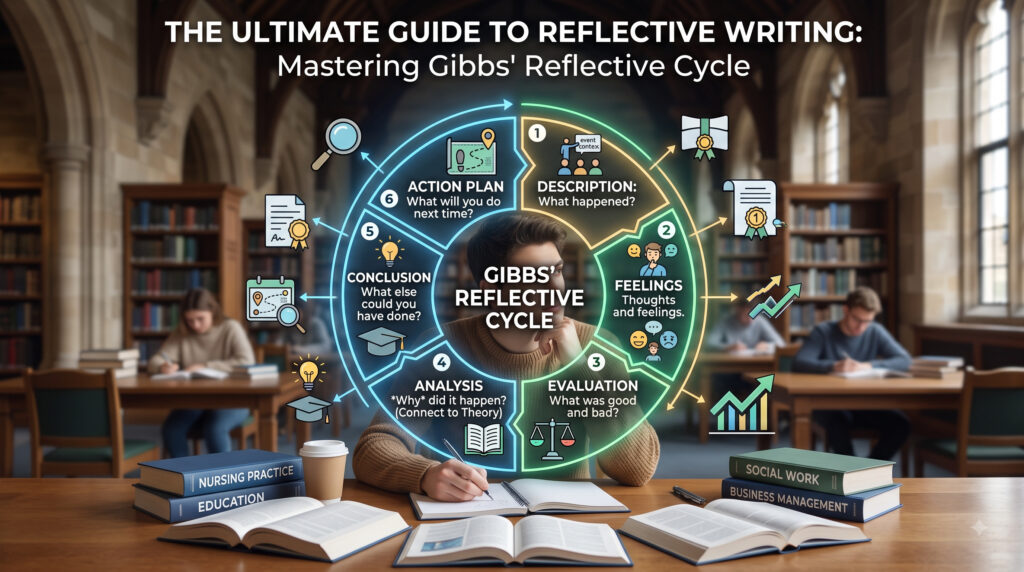
The Ultimate Guide to Reflective Writing: Mastering Gibbs’ Reflective Cycle
If you have spent your academic career mastering the art of the objective, third-person academic essay, being asked to write a “reflective journal” or “reflective essay” can feel like a sudden shock to the system.
For many students—especially those studying Nursing, Education, Social Work, or Business in the UK—reflective writing is a mandatory and heavily weighted part of the curriculum. However, tutors rarely want a simple diary entry. They are looking for “Reflective Practice”: a structured, critical analysis of a real-world experience designed to improve your future professional performance.
The gold standard for structuring these assignments is Gibbs’ Reflective Cycle (1988). In this guide, we will break down the six stages of the cycle, show you how to transition from descriptive writing to critical reflection, and help you secure top marks on your next assignment.
Why Do UK Universities Use Gibbs’ Reflective Cycle?
Reflective writing asks you to do something that standard academic essays explicitly forbid: use the word “I” and discuss your feelings.
However, universities use models like Gibbs’ to ensure that your reflection does not become an unstructured rant. The cycle forces you to systematically break down an event, analyse why it happened, and create a tangible plan for the future. Whether you are reflecting on a group presentation in a business module or a clinical placement in healthcare, Gibbs’ framework keeps your writing academically rigorous.
The 6 Stages of Gibbs’ Reflective Cycle Explained
To develop a coherent argument in a reflective essay, you should dedicate a specific section (or paragraph) to each of the following six stages.
| Stage | Focus | Key Questions to Ask Yourself |
| 1. Description | What happened? | Who was there? What was the context? What did you do? |
| 2. Feelings | What were you thinking/feeling? | How did you feel before, during, and after the event? |
| 3. Evaluation | What was good and bad? | What went well? What didn’t work? How did you contribute? |
| 4. Analysis | Why did things happen this way? | How do academic theories explain this event? |
| 5. Conclusion | What else could you have done? | What did you learn from this specific situation? |
| 6. Action Plan | What will you do next time? | If it happens again, what specific steps will you change? |
Stage 1: Description
Keep this section brief and factual. Do not start analysing yet. Simply set the scene for your tutor.
-
Example: “During my first-year teaching placement, I was tasked with leading a 30-minute seminar on Shakespeare for a class of 15 students.”
Stage 2: Feelings
This is where you bring in your emotional response. Do not be afraid to admit if you were nervous, frustrated, or overwhelmed.
-
Example: “Before the session, I felt anxious about managing classroom behavior. During the task, I felt overwhelmed when students stopped paying attention.”
Stage 3: Evaluation
Look at the event objectively. What were the positive and negative aspects?
-
Example: “The positive aspect was that my lesson materials were well-prepared. The negative aspect was that my time management failed, and I rushed the final activity.”
Stage 4: Analysis (The Most Important Stage)
This is where you earn your marks. This section must transition from storytelling to critical analysis. You must bring in external academic literature to explain your evaluation.
-
Example: “My inability to manage the classroom disruption can be explained by Smith’s (2020) theory of assertive discipline, which suggests that a lack of immediate boundaries leads to a loss of authority. My approach was too passive, aligning with…”
Stage 5: Conclusion
Summarize your key learnings. What is the main takeaway from the analysis you just conducted?
-
Example: “I have learned that thorough lesson planning is not enough; proactive behavior management is equally critical to a successful seminar.”
Stage 6: Action Plan
Give your tutor concrete, actionable steps you will take to improve in the future.
-
Example: “Before my next placement, I will attend a workshop on behavior management and implement the ‘wait time’ technique (Jones, 2019) to ensure I have the classroom’s full attention before speaking.”
3 Common Mistakes to Avoid in Reflective Writing
1. Spending Too Much Time on the “Description”
The biggest mistake UK students make is using 80% of their word count to tell the story (Description), leaving no room for the Analysis or Action Plan. As a general rule, the Analysis should be the longest section of your essay.
2. Forgetting to Use Academic References
Just because it is a personal reflection does not mean you can ignore literature. Your tutor wants to see that you can connect your personal experiences to the theories taught in your lectures. Ensure you are integrating peer-reviewed journals and citing sources correctly.
3. Being Too Informal
While you are allowed to use first-person pronouns (“I felt”, “My experience”), the language must remain professional. Avoid slang, contractions, and conversational tones. Treat it with the same academic respect as a standard dissertation and be sure to check for common grammar mistakes to avoid in academic writing.
Need Help Structuring Your Reflection?
Reflective writing requires a delicate balance of personal honesty and rigid academic analysis. If you are struggling to make your reflections sound critical enough for a First-Class or 2:1 grade, our UK academic specialists can help.
At SchoolUs, we offer expert proofreading, editing, and ethical assignment help designed specifically for UK University standards.